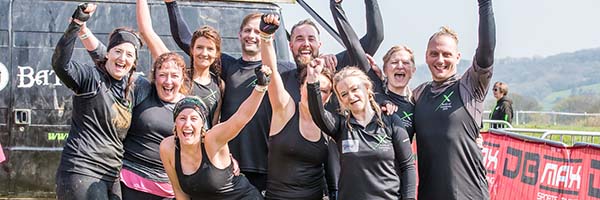
There’s a moment in every HYROX Doubles race when you look across at your partner, both of you halfway through a set of wall balls, sweat dripping off your noses, and you silently wonder why you ever agreed to this. Then they hand over the ball, you take your turn, and somehow the whole thing feels possible again.
That’s the magic of racing as a pair. HYROX on your own is a brilliant test of fitness. HYROX with a mate is a brilliant test of fitness and friendship – and if you’re an obstacle racer who already loves the shared-suffering side of the sport, Doubles might be your new favourite thing.
We’ve written before about why OCR athletes should consider HYROX. This time we’re getting practical: how to train for HYROX Doubles, how to split the work, and how to cross the line still on speaking terms.
First, how Doubles actually works
A HYROX race is eight 1km runs, each followed by a workout station: SkiErg, sled push, sled pull, burpee broad jumps, rowing, farmers carry, sandbag lunges and, finally, wall balls. It’s the same format whether you race solo or as a pair.
In Doubles, you and your partner run every kilometre together. Then, at each station, you share the work however you like – but only one of you can be working at any time. You might go 50/50, you might split it 70/30 in favour of the stronger rower, or you might swap every ten reps. There’s no rule about how you divide it, which is exactly where the strategy (and the occasional bickering) comes in.
Doubles is faster and less brutal than solo, but it rewards teamwork and planning – both of which can be trained.
Choose your partner wisely (or at least honestly)
The ideal Doubles partner isn’t necessarily the fittest person you know. It’s someone you can run with comfortably, who won’t sulk when you take the longer stint on the sled, and who’ll still laugh when it all goes a bit wrong at the 6km mark.
Before you enter, have the awkward conversation: what are you each hoping for? If one of you wants a podium and the other wants a nice day out and a medal for the fridge, you need to know that now, not halfway through the burpee broad jumps.
It also helps to be roughly matched on running pace, because you’ll be covering 8km side by side. A small gap is fine, but a big one means somebody spends the whole race either hanging on for dear life or jogging on the spot.
Work out your strengths before race day
Most pairs have natural specialists. One of you might love the rower and loathe the sled. The other might be built for farmers carries but turn into a puddle at the sight of a wall ball target.
Spend a session or two going through each station together and be brutally honest about who’s better at what. Then build a rough plan:
- Machines (SkiErg and row): easy to split by distance – one of you does 500m, the other does 500m – or by time if you’d rather swap every minute.
- Sleds: these tend to reward short, powerful efforts. Many pairs swap after every length so neither of you grinds to a halt.
- Burpee broad jumps and lunges: split by distance, and play to whoever moves better when tired.
- Farmers carry: often best split into chunks, so the grip doesn’t give out (OCR racers, your grip training finally gets its moment).
- Wall balls: small sets with fast changeovers usually beat one big heroic set followed by a collapse.
Write the plan down. Then accept that you’ll probably tear it up on the day and adapt – that’s fine too.
Practise the changeovers (yes, really)
This is the bit most pairs skip, and it’s where a surprising amount of time goes missing. Every swap involves handing over equipment, getting into position and getting going again. Do that badly fifty times in a race and you’ll lose minutes.
In training, rehearse the handovers. Agree simple calls – “five more”, “swap”, “go” – so nobody’s left guessing. On the rower, practise getting in and strapping up quickly. On wall balls, decide who catches and who throws next before you start. It feels silly in an empty gym, but pays off when you’re both breathing like steam trains.
Train together – but not every time
Training as a pair is one of the best things about Doubles. It’s more fun, it keeps you accountable on dark, wet November evenings, and it teaches you how each other moves when tired. Aim for at least one shared session a week where you practise race-style work: run 1km together, then split a station, then repeat.
A simple partner session might look like this:
- 4 rounds of: 1km run together, then 500m row split between you, then 30 wall balls in sets of 10, then 100m farmers carry split in two
- Rest 2 minutes between rounds, and practise your swaps every time
But don’t do everything together. You’ll each need your own running and strength work to build the engine underneath. Two or three runs a week, plus a couple of strength sessions built around legs, pushing, pulling and carrying, will cover most of what HYROX asks of you. If you’ve been building your off-season OCR base, you’re already well on your way.
Pacing as a pair
The biggest pacing mistake in Doubles is getting carried away on the first run because you’re excited, chatty and surrounded by people. Start steady. Seriously. The runs feel easy in kilometre one and very much not easy in kilometre seven.
Agree on a pace that the slower runner can hold all the way through, and stick to it. It’s far better to finish strong together than to watch your partner wilt while you shuffle back to collect them.
At the stations, keep an eye on each other. Doubles is the only race where you’re allowed to say “you look rough, I’ll take the next set” – and it’s often the smartest move you’ll make all day.
Communication: the hidden fitness
You can train every station perfectly and still come unstuck if you stop talking. The best pairs keep up a constant, simple flow of information: how many reps are left, how they’re feeling, when they need a longer break.
A few ground rules worth agreeing in advance:
- No silent suffering – if you’re struggling, say so
- Encourage, don’t coach mid-set (nobody wants technique tips on wall ball 74)
- Celebrate every station finished, however small
The real reason to race Doubles
Yes, Doubles is quicker. Yes, you can lean on your partner’s strengths. But the best bit is the same thing that makes OCR so special: you’re doing something hard alongside someone else, and that makes it more fun, more memorable and (usually) more successful.
That shared-mission spirit is exactly what we love about obstacle racing too – and plenty of our Rood Rampage regulars race in teams for the same reason. So grab a training buddy, pick a race, and start practising your high fives. You’re going to need them.
Back to Blog